Is AI Making Us Worse at Our Jobs? The Complete Guide for 2026
Key Takeaways
- ✓AI improves task completion speed by up to 37% for knowledge workers.
- ✓Lower-skill workers benefit the most, effectively democratizing expertise.
- ✓Heavy AI usage can lead to cognitive offloading and reduced critical thinking.
- ✓Automation bias creates dangerous blind spots when AI makes mistakes.
- ✓Top performers schedule "AI-off" time to keep their analytical skills sharp.
- ✓Top performers use AI to go faster, but they use "AI-off" time to go deeper. They treat algorithms as collaborative thought partners rather than infallible answer machines. Furthermore, they always verify factual claims before publishing or presenting them to a client.
"Expert Summary: Is AI making us worse at our jobs? The short answer is yes and no. While AI dramatically boosts speed and democratizes expertise, heavy reliance can lead to "cognitive offloading" and skill atrophy. The key is balancing AI assistance with manual deep work to prevent automation bias.
Have you ever stared at a blank screen, waiting for ChatGPT to do the thinking for you? We are all thrilled about what artificial intelligence can accomplish today. However, very few people are asking what AI might be doing to us.
If you rely on algorithms for every draft, email, and code snippet, you might be quietly hollowing out your own cognitive skills. Fortunately, the research is finally starting to roll in. Some of these findings are genuinely uncomfortable for modern knowledge workers.
There is a purely optimistic story where artificial intelligence is just another tool like a calculator. On the flip side, there is a darker version where we face massive cognitive dependency. Let's dive deep into the question: is AI making us worse at our jobs, and how can you protect your professional edge?
Understanding these takeaways is just the beginning of the journey. To truly grasp the impact of artificial intelligence, we need to define the core problem clearly. Let's look at what this phenomenon actually means for your daily routine.
What Does "Is AI Making Us Worse At Our Jobs" Actually Mean?
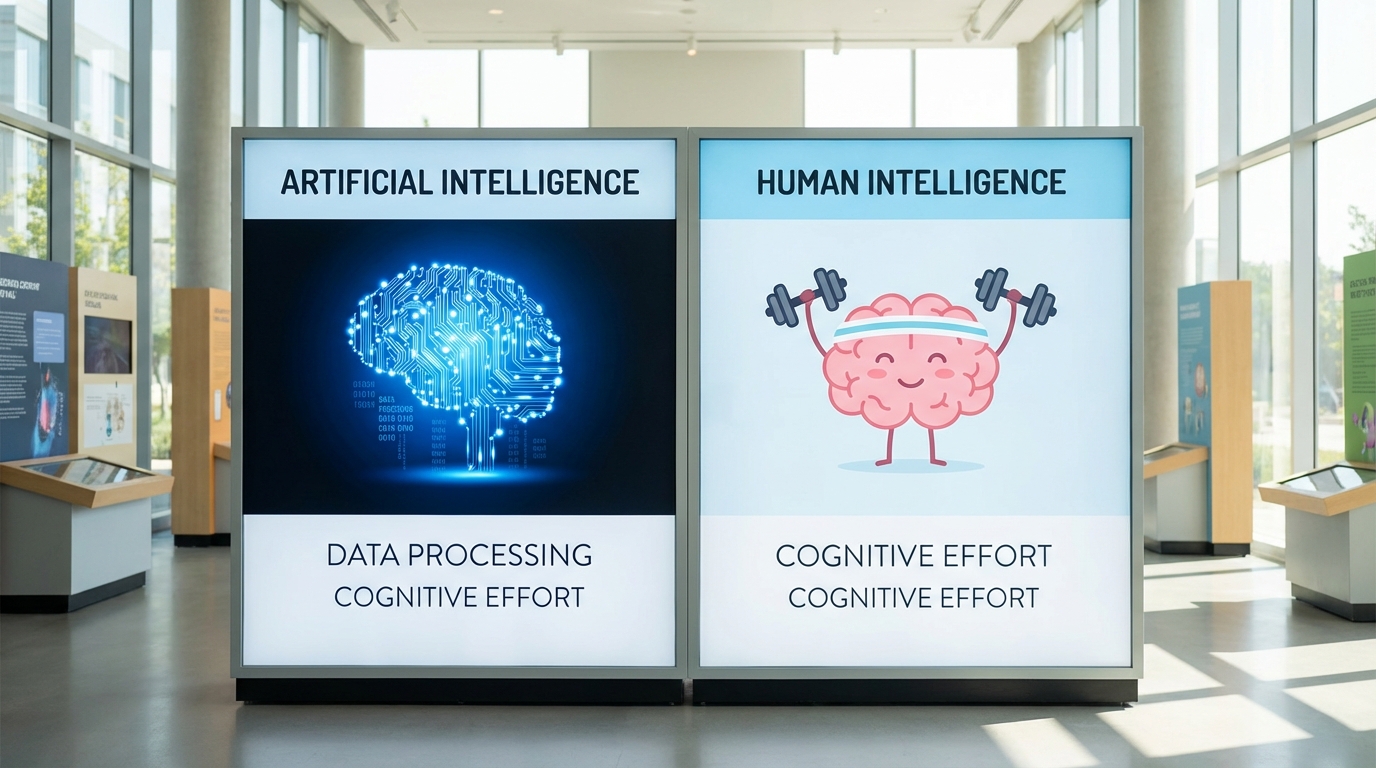
Is AI making us worse at our jobs? This phrase refers to the concept that over-relying on artificial intelligence tools causes a measurable decline in human critical thinking, deep research skills, and analytical reasoning over time.
Think about how GPS completely changed our spatial navigation abilities. If you use a digital map every day for two years, your natural sense of direction declines measurably. The exact same principle applies to your brain at the office.
When algorithms handle your writing and research for months, your cognitive muscles begin to weaken. But here's the interesting part... This phenomenon is scientifically known as cognitive offloading.
A 2024 Microsoft-Carnegie Mellon study found that heavy AI users showed measurably reduced critical thinking engagement. Participants invested far less effort in problem-solving when they knew an algorithm was readily available.
"Expert Insight: You must treat AI as a thought partner, not an answer machine. Push back on its outputs and ask follow-up questions to keep your brain actively engaged.Therefore, the cognitive risks are absolutely real and measurable. However, we cannot ignore the massive benefits that these tools provide. Let's explore the optimistic side of the equation next.
The Optimistic View: How AI Boosts Productivity
The productivity evidence supporting artificial intelligence is real, significant, and undeniable. A recent 2024 study from MIT revealed that workers using these tools completed tasks 37% faster. Furthermore, these employees reported much higher job satisfaction overall.
Another Stanford study focusing on GitHub Copilot found similar incredible results. Developers wrote code 55% faster and felt significantly less frustrated during their shifts. These statistics prove that algorithms excel at eliminating repetitive cognitive load.
Imagine if the last time you spent hours formatting a spreadsheet, that tedious task vanished in three seconds. More importantly, research shows this technology is actively leveling the playing field.
The Darker Side: Cognitive Offloading and Skill Atrophy
Here is where the conversation gets a bit uncomfortable for tech enthusiasts. A separate study from Harvard Business School examined consultants using advanced algorithms. These professionals were highly likely to produce excellent, high-quality outputs initially.
Wait for it... When the artificial intelligence was wrong, the AI-assisted consultants were significantly more likely to miss the error. Those who worked entirely without digital assistance caught the mistakes much faster.
This perfectly illustrates the danger of cognitive dependency in high-stakes environments. We must also address the massive skill atrophy question facing our workforce. What happens to your deep research skills when a chatbot handles the heavy lifting for five years?
Your tolerance for slow, deliberate thinking naturally decreases over time. You start craving instant answers instead of wrestling with complex problems. Consequently, losing our tolerance for deep thought is a massive threat to knowledge workers.
This dynamic leads us directly to the most dangerous psychological trap of all. Let's examine why our brains blindly trust machines even when they fail.
The Hidden Danger of Automation Bias
The most consistent finding across cognitive science research is a concept called automation bias. This is the human tendency to over-trust automated systems, even when they are blatantly wrong. We have already seen this exact issue with self-driving cars and medical diagnostic tools.
Now, this bias is rapidly infiltrating our daily office work. Let's look at the uncomfortable math behind this psychological trap. Suppose your digital assistant is right 95% of the time, so you naturally stop double-checking its work.
Because it is usually right, you are now making 5% errors where you previously only made 2%. The tool absolutely improved your average output speed. Sadly, it also created a dangerous tail risk for catastrophic mistakes.
"Pro Tip: Always maintain a clear mental model of what algorithms are likely to get wrong in your specific industry. Blind trust is the ultimate enemy of excellence.
Understanding automation bias is crucial for protecting your career long-term. To make this even clearer, we need to look at the pros and cons side by side. Here is exactly how this technology helps and hurts us.
AI Makes Us Better vs. Worse: The Ultimate Comparison
Is AI making us worse at our jobs, or is it our greatest asset? The evidence points in both directions simultaneously. We need to visualize these impacts to understand the full picture.
| How AI Makes Us Better | How AI Makes Us Worse |
|---|---|
| Eliminates repetitive cognitive load | Atrophies deep research skills |
| Speeds up first drafts dramatically | Reduces tolerance for slow thinking |
| Surfaces options humans might miss | Creates over-reliance on simple answers |
| Allows focus on higher-order work | Weakens ability to work without tools |
| Democratizes access to expertise | Homogenizes outputs across industries |
As you can see, the benefits focus entirely on speed and efficiency. Conversely, the drawbacks target our fundamental cognitive abilities. This divergence is exactly what separates the high-performers from the average workers.
Recognizing these differences gives you a massive advantage over your peers. Now that you see the risks, you need a highly practical strategy. Let's break down the exact steps top professionals use to stay sharp.
5 Actionable Steps to Use AI Without Losing Your Edge
The most skilled users operate differently than the average knowledge worker. They deliberately build their skills alongside the technology. Here is how you can do the exact same thing.
- 1Always verify factual claims. Never copy and paste statistics without checking the original source. You must assume the algorithm is hallucinating until proven otherwise.
- Schedule "AI-off" work. Tackle hard, complex tasks completely manually at least once a week. This deliberate friction keeps your analytical reasoning skills incredibly sharp.
- Treat the tool as a thought partner. Stop treating chatbots like simple answer machines. Push back on their logic, ask challenging follow-up questions, and debate the results.
- Map out industry blind spots. Maintain a clear mental model of what algorithms misunderstand in your specific field. Know exactly where the machine's knowledge ends and yours begins.
- Track your independent skill development. Measure your core competencies without any digital assistance. Ensure you are actually getting better at your craft, not just getting faster at prompting.
Implementing these five steps will absolutely protect your cognitive abilities from degrading. However, you likely still have some lingering questions about this topic. Let's address the most common concerns people have right now.
Conclusion
So, is AI making us worse at our jobs? The final verdict is incredibly complicated. Artificial intelligence is not making us universally better or worse across the board.
Instead, it is creating a massive divergence in the modern workforce. Those who use it thoughtfully are becoming wildly productive without losing their edge. Meanwhile, those who use it as a crutch are walking into a serious skill deficit.
You might not notice this deficit until the system is confidently wrong about something critical. The question is no longer whether you should use these tools.
The real question is whether you are building your skills alongside them or trading them away for convenience.
? Frequently Asked Questions
Does AI decrease critical thinking?▼
What is automation bias in the workplace?▼
Can artificial intelligence cause skill atrophy?▼
How do top performers use AI differently?▼
Topics
Written By
Sarah Chen
Author & Contributor at Mixmaxim. Covering B2B SaaS, AI Tools, and Enterprise Software.