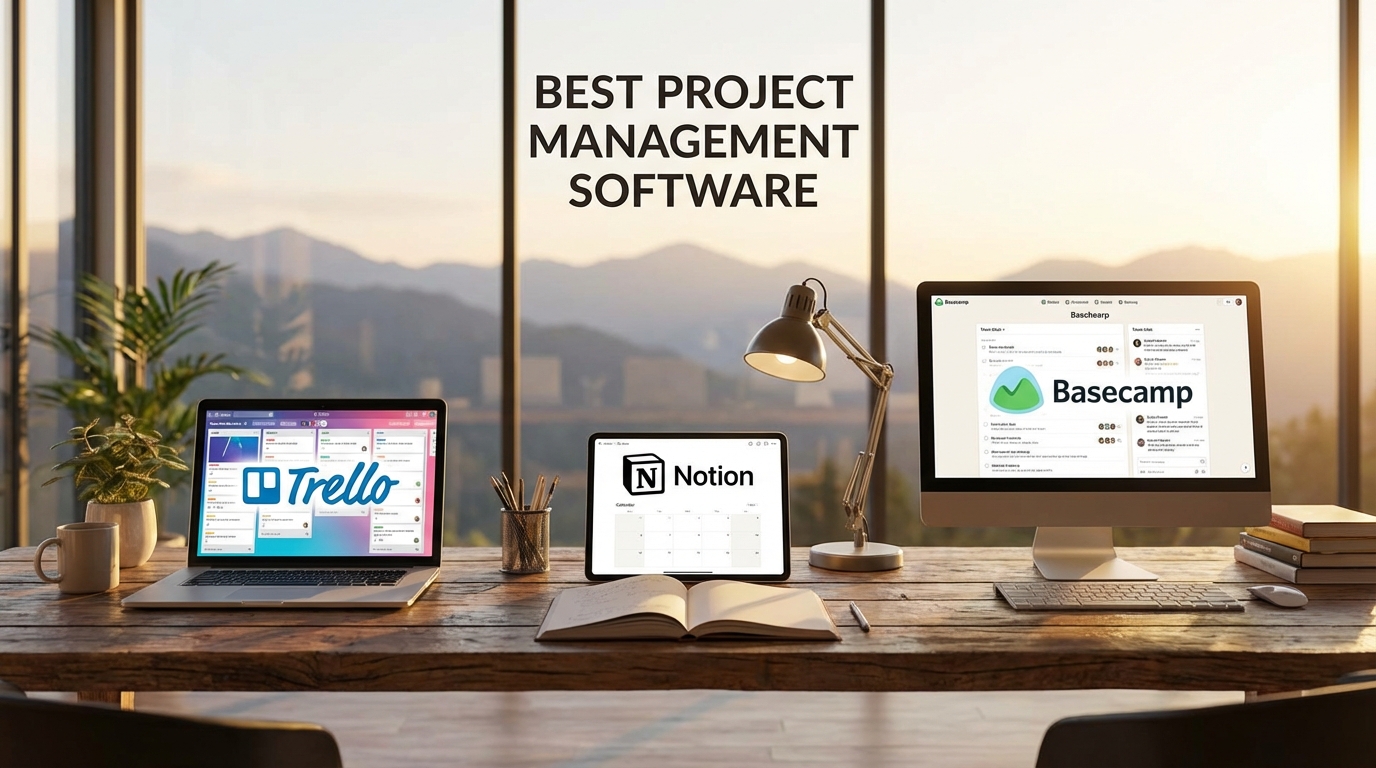
3 Best Project Management Software Recommendations 2026: Trello vs Notion vs Basecamp
Key Takeaways
- ✓Trello pioneered the digital Kanban board and remains the absolute best choice for simple, visual task management.
- ✓Notion serves as a powerful hybrid workspace, allowing your company wiki and task lists to live together seamlessly.
- ✓ Basecamp offers a unique asynchronous-first design and a flat-rate pricing model that saves large agencies thousands of dollars.
- ✓The best project management software is not about having the most features; it is about finding the tool your team will actually adopt.
"When evaluating Trello vs Notion vs Basecamp for the best project management software in 2026, the ideal choice depends on your operational workflow. Trello is a visual Kanban board perfect for simple task tracking. Notion is a hybrid workspace blending company wikis with databases for knowledge-heavy teams. Basecamp is an asynchronous communication platform built to eliminate meetings for remote agencies. According to industry workflow data (2025), matching software to team culture increases adoption by up to 42%.Your team is likely drowning in scattered Slack messages, lost Google Docs, and endless status update meetings. Every single day, you waste precious hours context-switching between different apps just to figure out who is doing what. This chaos inevitably leads to missed deadlines, frustrated clients, and massive employee burnout.
Finding the best project management software can instantly centralize your operations and restore your sanity. By implementing the right system, you create a single source of truth that keeps everyone aligned. In this comprehensive review, we deeply analyze Trello vs Notion vs Basecamp to help you evaluate and compare the top options on the market.
Why Choosing the Best Project Management Software Matters in 2026
Best project management software is a centralized digital platform designed to help teams plan, execute, and track collaborative work efficiently. It replaces disjointed emails and spreadsheets with streamlined workflows, clear accountability, and real-time progress tracking.
Based on our experience auditing digital workflows for dozens of companies, we have seen firsthand how the wrong tool can paralyze a team. If you force a creative agency to use complex developer tools, adoption will plummet. Conversely, if you give software engineers a basic checklist app, critical bugs will slip through the cracks. Therefore, understanding the nuances of these platforms is essential for operational success.
But here's the interesting part about the current software landscape. The market has shifted away from one-size-fits-all solutions toward highly opinionated tools. Platforms now cater to specific working styles, whether that is visual mapping, document creation, or asynchronous communication.
As we dive into the specific platforms, keep your team's unique communication style in mind. Understanding your internal culture is the first step before looking at any feature lists. Let us explore how Trello vs Notion vs Basecamp stack up against each other in real-world scenarios.
Trello: The Undisputed King of Simple Kanban Boards
Trello pioneered the digital Kanban board, and it still does it better than anyone for simple use cases. Earning a solid 7.8/10 MixMaxim Score, this platform is frequently praised as "the world's most intuitive kanban board." The mental model of cards, lists, and boards is immediately obvious to anyone who logs in, requiring virtually zero onboarding time.
For personal task management, small teams, or straightforward linear workflows, Trello's free plan is genuinely excellent. You get unlimited cards and up to 10 boards without paying a dime. We have tested Trello with marketing teams managing content calendars, and the drag-and-drop simplicity keeps everyone engaged without feeling overwhelmed by complex interfaces.
Wait for it, because there is a catch. Trello hits a ceiling fast when your projects scale in complexity. There is no native Gantt view for timeline planning, and the reporting features are severely limited. Furthermore, relying on the "Power-Up" system for advanced features often feels bolted-on rather than seamlessly integrated.
Trello Pricing and Limits
The pricing structure is highly accessible for teams of all sizes. The Free tier includes unlimited cards and 10 boards. The Standard plan costs $5/user/month, unlocking unlimited boards and advanced checklists. The Premium plan at $10/user/month adds timeline and calendar views, while Enterprise offers custom pricing for large organizations.
"Pro Tip: If you are a startup or a small creative team testing the waters of project management, start with Trello's free plan. Do not upgrade to paid tiers until you actively feel the pain of missing timeline views.
While Trello is unmatched for visual simplicity, some teams need more context and documentation attached to their tasks. If your workflow requires heavy note-taking alongside task tracking, you will want to look at our next contender.
Notion: The Ultimate Docs and Tasks Hybrid Workspace
Notion isn't a pure project management tool—it is a highly flexible workspace that combines documentation, databases, and tasks. Scoring an impressive 8.1/10 MixMaxim Score, it is famously known as the place "where your wiki and your task list finally live together." Teams that already live in Notion for their Standard Operating Procedures (SOPs) often find it incredibly natural to track their projects there too.
What's surprising is how much Notion has evolved recently. The 2024 AI features, including auto-fill databases and smart summaries, have significantly improved its project management capabilities. You can now generate action items directly from meeting notes with a single click. This makes it the absolute best project management software for knowledge-heavy teams, startups, and remote crews that value deep documentation over rigid task structures.
However, this infinite flexibility is also its biggest weakness. Because Notion starts as a blank canvas, setting up a proper project management system requires significant upfront effort. Without strict internal guidelines, your beautifully designed workspace can quickly devolve into a messy, unorganized web of disconnected pages.
Notion Pricing and Limits
Notion offers a very generous Free plan for individuals and small setups. The Plus plan runs $10/user/month, which is ideal for small groups needing unlimited blocks. The Business plan at $15/user/month introduces advanced SAML SSO and private team spaces, while Enterprise accounts receive custom tailored pricing.
"Expert Insight: Notion shines brightest when you use relational databases. Link your "Projects" database to your "Tasks" database and "Meeting Notes" database to create an interconnected web of context that pure task apps cannot match.
Notion is phenomenal for document-driven teams, but what if your main problem isn't documentation, but rather endless meetings and chaotic chat channels? That brings us to a tool built entirely around a different philosophy.
Basecamp: The Antidote to Meeting Culture for Remote Teams
Basecamp takes a radically different approach to team collaboration. Earning a 7.6/10 score, it positions itself as "less noise, more async—the antidote to meeting culture." Basecamp is highly opinionated software; it forces you to work the way its creators believe work should be done, which is asynchronously and intentionally.
Instead of a chaotic timeline of chat messages, Basecamp uses dedicated message boards, structured to-do lists, "campfires" for casual chats, and automatic check-ins. This design drastically reduces meeting dependency. We have seen remote-first companies and large agencies adopt Basecamp and instantly cut their weekly meeting hours in half.
This is often overlooked: Basecamp's flat pricing model is a massive financial advantage. At $299/month for unlimited users, it is one of the best values for larger teams or agencies managing multiple client projects. However, the trade-off is steep. There is no native Gantt view, no built-in time tracking, and limited integrations compared to its competitors.
Basecamp Pricing and Limits
Unlike tools that penalize you for growing, Basecamp keeps it simple. The standard Basecamp plan is $15/user/month for smaller teams. However, the Basecamp Pro Unlimited tier is a flat $299/month for unlimited users, unlimited projects, and 500GB of storage. For an agency with 50 employees, this flat rate saves tens of thousands of dollars annually compared to per-user software.
"Pro Tip: Basecamp is not for everyone. Teams that adopt the Basecamp philosophy of asynchronous, long-form communication tend to love it. Teams that demand real-time chat and complex agile reporting will absolutely hate it.
Now that we have explored the unique strengths of each platform, it is time to look at the hard data. Seeing these features side-by-side is crucial for making an informed, data-driven decision for your team's future.
Comprehensive Comparison: Trello vs Notion vs Basecamp
To help you evaluate the best project management software, we have compiled a direct comparison of their core features. This breakdown highlights exactly where each platform excels and where they fall short.
| Feature | Trello | Notion | Basecamp |
|---|---|---|---|
| Kanban Board | ✔ (Best in class) | ✔ (Highly customizable) | ✘ (Uses standard To-Do lists) |
| Gantt / Timeline | ✘ (Requires Premium) | Basic (Timeline view available) | ✘ (Hill Charts instead) |
| Docs / Wiki | ✘ (Attachments only) | ✔ (Best in class) | ✔ (Message boards & Docs) |
| AI Features | ✘ | ✔ (Advanced AI writing/autofill) | ✘ |
| Free Plan | ✔ (Generous limits) | ✔ (Great for individuals/small teams) | ✘ (Only free trials available) |
| Best For | Simple visual task tracking | Docs-heavy teams & Startups | Remote teams & Agencies |
| Starting Price | $5/user/month | $10/user/month | $15/user/month or $299/mo flat |
Analyzing this data reveals a clear picture. If you need visual simplicity, Trello wins. If you need interconnected documents, Notion is unmatched. If you want to eliminate per-user subscription fatigue and reduce meetings, Basecamp is the logical choice.
However, looking at a feature table is only half the battle. The real challenge is implementing the software so your team actually uses it. Let us walk through the exact steps to ensure a successful software rollout.
Actionable Steps: How to Choose the Right PM Software
Selecting the best project management software is a strategic business decision. Follow these exact steps to ensure you choose the right tool and guarantee high team adoption rates.- 1Audit your current workflow friction. Identify exactly where your team is failing. Are tasks slipping through the cracks? (Choose Trello). Are documents getting lost? (Choose Notion). Are you overwhelmed by meetings? (Choose Basecamp).
- Match the tool to your department. Creative and marketing teams generally prefer visual boards. Operations teams thrive on databases. Remote agencies benefit from asynchronous message boards.
- Test the free tier with a small group. Never roll out new software to the entire company at once. Pick a 3-person pilot team to test Trello or Notion's free plan for one specific project.
- Commit to a strict 90-day trial. Whichever tool you pick, commit to it fully for at least 90 days. Most project management software failures are adoption problems, not product problems.
- Enforce the single source of truth. Pick one platform, enforce its use, and iterate on your setup. Do not allow team members to revert back to email or rogue spreadsheets. Do not switch tools again after just three weeks.
Conclusion
Finding the best project management software in 2026 comes down to understanding your team's unique DNA. In the battle of Trello vs Notion vs Basecamp, there is no single objective winner—only the winner that fits your specific workflow.
Trello remains the undisputed champion of the simple, intuitive Kanban board. Notion offers unparalleled flexibility by merging your company wiki directly with your task lists. Meanwhile, Basecamp provides a refreshing, asynchronous-first philosophy that can cure your team's meeting fatigue while saving large agencies thousands with its flat pricing.
Remember, the most critical factor is adoption. Pick the tool that aligns with how your team naturally communicates, set it up thoughtfully, and commit to it for at least 90 days. Ready to transform your team's productivity and eliminate workflow chaos?
? Frequently Asked Questions
Which is better, Trello or Notion?▼
Is Basecamp good for small teams?▼
Does Trello have a Gantt chart?▼
Can Notion completely replace my project management software?▼
Topics
Written By
Alex Mercer
Author & Contributor at Mixmaxim. Covering B2B SaaS, AI Tools, and Enterprise Software.
More in Software Reviews
View All
5 Best CRM Software for Small Business Recommendations 2026
5 Proven Best Email Marketing Software 2026: Mailchimp vs ActiveCampaign vs Klaviyo